Clear aligners in Jersey City typically run $3,500 to $8,000 for a full case, depending on how many trays your case requires, whether you need refinements, and whether you go with Invisalign or another clear aligner system. Most patients at Limitless Dental® land between $4,500 and $6,500, and finance the case at roughly $150 to $300 a month with no interest for the first 6 to 24 months through CareCredit, Proceed, or Cherry.
That is the direct answer. The rest of this post is the honest version of what actually drives that number, how the treatment itself works from your first scan to the retainer you will wear for life, and the questions I get asked over and over in my Jersey City office by patients who are shopping this decision.
I am Dr. Nick Ciardiello, DMD, FICOI. I own Limitless Dental® at 314 Coles Street in Jersey City, and I have planned hundreds of clear aligner cases for adults in Hudson County. If you are weighing this treatment, this is what I would want you to know before you sit down with any dentist.
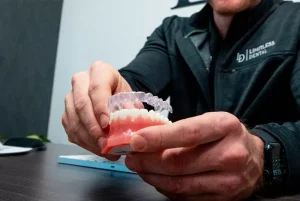
What clear aligners actually are (and how Invisalign fits in)
Clear aligners are thin, custom-fit plastic trays that snap over your teeth and move them a fraction of a millimeter at a time. You wear each tray for about a week, then switch to the next one in the series. Over months, the series walks your teeth into a straighter position.
Invisalign is the best-known brand of clear aligner, made by Align Technology. It is one system out of several. The American Association of Orthodontists describes clear aligners generally as “clear, thin, plastic-like trays that are custom-formed to fit your mouth and sequentially apply pressure” (AAO, Aligners). The plastic is not doing anything magical. It is a very precise engineering job: the tray is shaped slightly differently than your teeth sit today, and the mismatch is what applies the pressure that moves them.
In my Jersey City office we offer both Invisalign and CandidPro. Neither one is “better” in the abstract. What matters is which system matches the movement your case needs. A case that needs a lot of rotational movement on cuspids or premolars, for example, is harder to move predictably with any aligner. A 2018 systematic review in Progress in Orthodontics found that clear aligners “can predictably level, tip, and derotate teeth (except for cuspids and premolars)” and are best suited for “correction of mild to moderate malocclusions in non-growing patients” (Papadimitriou et al., Prog Orthod 2018). For most Jersey City adults with crowding, spacing, mild bite issues, or relapse from teenage braces, aligners are a perfectly appropriate tool. For very complex bite corrections or big skeletal problems, they are not the right tool, and I will tell you that up front.
How much do clear aligners cost in Jersey City?
Here are the honest ranges you will see across Hudson County offices in 2026:
- Simple cases (mild crowding or spacing, 10 to 20 trays, 6 to 9 months): $3,500 to $5,000
- Moderate cases (more crowding, some rotation, 20 to 40 trays, 9 to 15 months): $5,000 to $6,500
- Comprehensive cases (both arches, bite work, 40+ trays, 15 to 24 months): $6,500 to $8,000+
- Touch-up or “single-arch” cases (one arch only, minor movement): $2,500 to $3,500
Those are all-in numbers. They include the digital scan, the treatment plan, all of the aligners in the series, in-office check-ins, refinements if you need them, and one initial set of retainers.
What actually drives the price
The single biggest cost driver is how far your teeth have to move. That drives the number of trays, and the tray count drives the lab bill your dentist pays to Align Technology or whatever aligner company they use. A 12-tray case and a 45-tray case are two different products.
Other factors that move the number:
- One arch or both. If only your lower teeth need work, the case can be almost half the price of a full upper-and-lower plan.
- Attachments and IPR. Attachments are small tooth-colored bumps we bond to specific teeth so the aligner can grip and rotate them. IPR (interproximal reduction) is a tiny amount of enamel filing between teeth to create space. Neither adds to your bill, but a case that needs a lot of both is usually a more complex case.
- Refinements. Most cases finish the initial series with a few teeth not quite where we planned. We take a new scan, order a second short series of trays, and finish the job. Reputable offices, mine included, build the first round of refinements into the original price. Ask your dentist that question directly. If refinements are extra, you can end up with a $2,000 surprise at month 10.
- Retainers. One set is typically included. Replacement retainers, or upgrading to a fixed lingual retainer bonded behind your front teeth, are separate.
- Whitening. A lot of Jersey City patients whiten during aligner treatment because the trays double as whitening trays. That is an add-on, usually $250 to $500.
Is $3,000 a good price for Invisalign?
Yes, for a small case. If a dentist quotes you $3,000, ask exactly what that includes: how many trays, whether refinements are covered, whether retainers are included, and whether it is single-arch or both arches. A $3,000 single-arch touch-up case is a fair price. A $3,000 quote for a comprehensive both-arch case is almost certainly missing something, and you will meet those hidden costs later.
Is $5,000 a lot for Invisalign?
No. $5,000 for a moderate both-arch case in Jersey City is a normal, fair price. If a case is being quoted below the $4,500 mark for real comprehensive work, I would want to know what is being trimmed out of the plan.
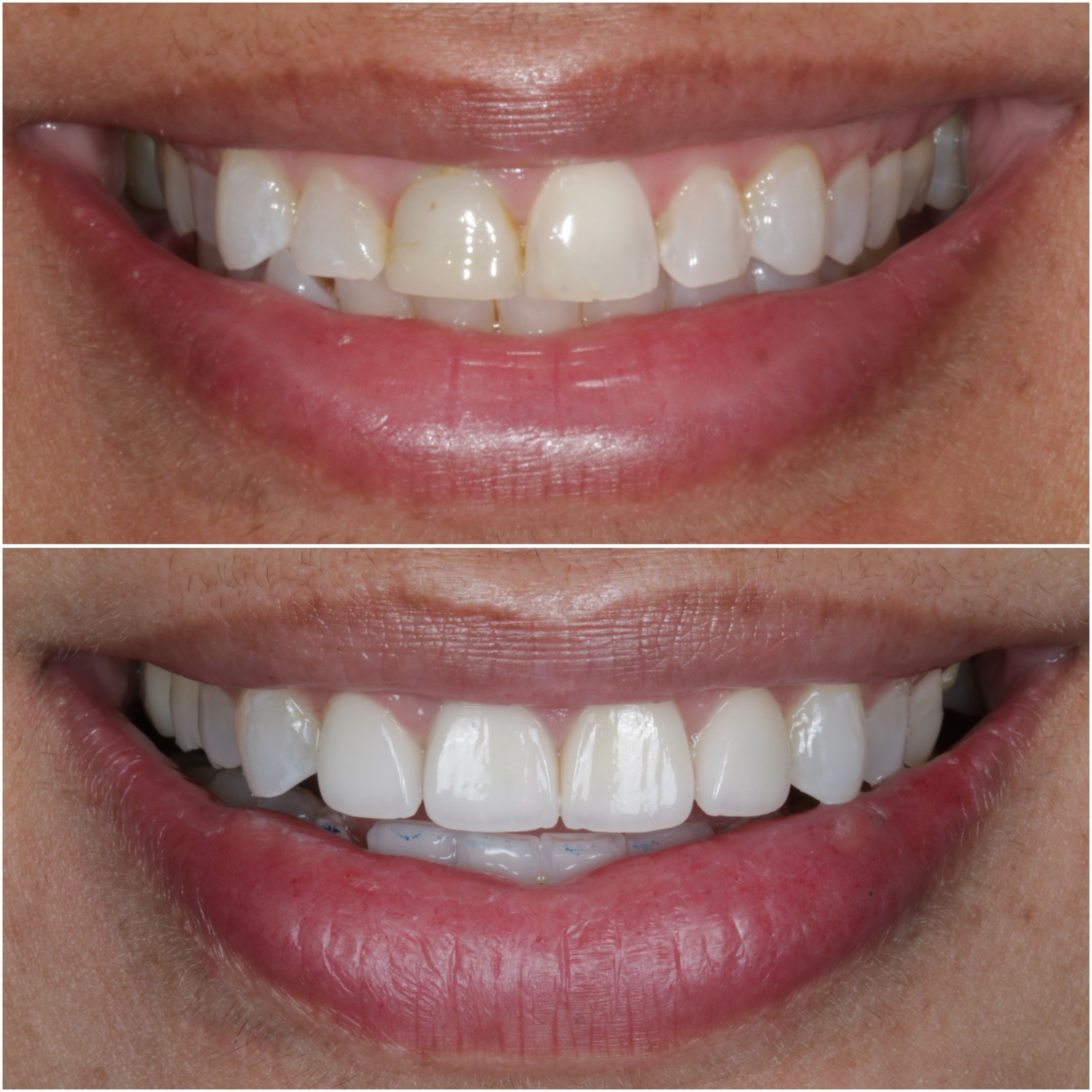
How Invisalign works, step by step
Here is what your treatment actually looks like from the first appointment to your final retainer. This is the exact workflow we use at Limitless Dental®, and it is fairly standard across offices that do this well.
Visit 1: Consult and scan
You come in, we talk about what is bothering you and what you want your smile to look like, and I do a full exam. Then a team member takes a digital scan of your teeth (no gooey impression trays). The scan takes about five minutes. We also take x-rays and photos so I have the full picture of your bite, your gum health, and your existing dental work.
At Limitless Dental® we hand you a Starbucks (yes, real Starbucks, hot coffee or hot chocolate, on the house) while you get scanned. That is not a gimmick. Long consults are more tolerable when you are not thirsty and cold. It is one of the ways we try to make dental appointments feel less like a medical procedure and more like a normal errand.
Visit 2 (usually a Zoom): Treatment plan review
I take your scan and design your treatment digitally. I decide which teeth move first, how much attachment work we need, whether we need any enamel reduction, and how many trays the case will take. Then we get on a short video call and I walk you through the plan, show you a computer simulation of what your teeth will look like at the end, and quote you a written price. Nothing starts until you say yes to the plan and the price.
Visit 3: Aligner delivery
Your aligner series arrives from the lab a few weeks later. You come in, we bond your attachments if your case needs them, and I place your first tray. You leave with the first several sets of trays and instructions. From here on out, you switch trays yourself, usually every 7 to 10 days.
Wear schedule (this is where cases succeed or fail)
You wear the aligners 20 to 22 hours a day. The AAO states plainly: “Each aligner is worn for 1 week at a time, at least 22 hours a day” (AAO, Aligners). You take them out to eat and to brush. Everything else, including sleeping, they stay in. Water is fine to drink with the trays in. Coffee, tea, and wine stain the trays and can also warp them, so those need to happen during your two-hour eating window.
If you cheat this and only wear them 12 to 14 hours a day, your teeth will not track to the tray, and I will have to reorder trays and extend your treatment by months. Aligner treatment is not passive. It works if you actually wear them.
Check-in visits (every 6 to 10 weeks)
You come in briefly so I can check that your teeth are actually moving on schedule and that the trays are seating fully. Most check-ins are 15 minutes. If a tooth is lagging, we might slow down or add a small attachment.
Visit ~5: Refinement scan
Toward the end of your initial series, most patients need a second short set of trays to finish a few small movements. I re-scan you, order the refinement trays, and we finish those over another 2 to 4 months.
Final visit: Delivery of retainers
Once your teeth are where we planned them, we remove the attachments, polish your teeth, and deliver your retainers. You wear the retainers full-time for a few months, then only at night. Forever. Teeth want to drift back to where they came from. If you stop wearing retainers, you will lose some or all of your correction, and that is the single most common reason people end up back in aligners in their 40s and 50s.
Does Invisalign actually work? The evidence
Yes, for the right cases. And I want to be careful with the word “right,” because you will see marketing for aligners that promises they can fix anything. That is not what the peer-reviewed literature shows.
A 2020 systematic review by Robertson and colleagues in Orthodontics & Craniofacial Research concluded that clear aligners “may produce clinically acceptable outcomes” comparable to fixed appliances for mild to moderate cases, though predictability remains limited for complex movements (Robertson et al., Orthod Craniofac Res 2020). A larger 2025 meta-analysis in the Journal of Evidence-Based Dental Practice found that clear aligners performed comparably to fixed braces on standard grading systems and had advantages in “chairside time, pain and root resorption” (Baneshi et al., J Evid Based Dent Pract 2025).
Translated to a Jersey City patient: aligners are as good as braces for most adult cosmetic and mild bite cases, they hurt less, they are less irritating to your gums and lips, and there is less risk of long-term root shortening. Where fixed braces still have the edge is very large tooth movements, severe bite corrections, and growing patients (kids and teens). The AAO reports that adult patients now make up “1 in 3 orthodontic patients today” (AAO, Adult Orthodontics), and aligners are a big part of why.
How long does clear aligner treatment take?
Most Jersey City cases run 6 to 18 months, with the average landing around 12 months for a moderate both-arch case. Simple single-arch touch-ups can finish in 4 to 6 months. Comprehensive cases with bite work can go 18 to 24 months.
The number of trays is not exactly the same as the number of months, because we often move faster than one tray a week for straightforward movements and slower for hard ones. I will give you a projected timeline at your treatment plan review, and I will update it honestly if we need more time.
Does insurance cover clear aligners?
Sometimes. Dental insurance is inconsistent on this one. Here is the pattern I see with Jersey City patients:
- Plans with orthodontic coverage: Usually cover 50% of orthodontic treatment up to a lifetime orthodontic maximum, typically $1,000 to $2,500. That maximum is separate from your regular annual dental max. The AAO notes that “dental plans with orthodontic coverage usually cover both traditional braces and clear aligners equally” (AAO, Aligners), so you generally do not get penalized for choosing aligners.
- Plans without orthodontic coverage: Cover nothing for aligner treatment. Most PPO plans sold as “basic” or “value” dental fall into this category.
- Medicaid / NJ FamilyCare: Covers orthodontics only in medically necessary cases, usually for kids. Adult aligners are not covered.
- Adult age limits: A few plans still cap orthodontic coverage at age 18 or 19. Read your policy.
You can also use HSA and FSA dollars for aligner treatment, which is a real tax advantage if you have those accounts through your employer. That alone can save a Jersey City patient 25 to 35% depending on their bracket.
When you come in for a consult, my front desk verifies your benefits before your treatment plan review so we can quote you the exact out-of-pocket number, not a guess.
What if I do not have insurance? Financing options at Limitless Dental®
Roughly a third of the patients I see for aligners do not have orthodontic coverage. Here is how we make it work at Limitless Dental®:
- CareCredit: The standard dental-industry line of credit. Interest-free short-term plans (6 to 24 months) if paid off inside the promotional window. Long-term plans up to 60 months at a fixed rate. Approval is fast and online.
- Proceed Finance: Higher limits (up to $60,000) and longer terms (up to 96 months). Good option if you are combining aligners with veneers or implant work in the same treatment plan.
- Cherry: Short-term plans, 3 months to 2 years, soft credit check, often gets approvals when other lenders decline.
- Limitless Dental® Savings Plan: Our in-office annual plan (not insurance). Members get $500 off Invisalign or clear aligner treatment plus discounts on cleanings, fillings, veneers, and implants. Individual plan is $549 a year. See Insurance & Financing for the full plan details.
Most patients combine two of these: insurance covers a slice, and CareCredit or Cherry covers the balance at $150 to $300 a month.
What should you ask before you start clear aligner treatment?
Before you sign anything, ask the dentist quoting you these five questions:
- Are refinements included in the price? If the answer is “extra,” expect to pay another $500 to $2,000 at month 8.
- How many sets of retainers are included, and are you offering a fixed lingual retainer? A bonded retainer behind your front teeth is the best insurance against relapse.
- Is the doctor personally designing my case, or is it being auto-planned by the software? The software gives a first-draft plan. A dentist who takes 30 minutes to modify that plan (adjusting which teeth move when, adding or removing attachments, controlling bite) will give you a better result than one who just clicks “approve.”
- What happens if a tray does not fit? If your dentist has to reorder a mid-treatment tray, is that included?
- What if I need bite work at the end? Some aligner plans open a small bite in the back that needs equilibration or small composite additions to close. Ask if that is included or extra.
Frequently asked questions
Is 35 too old for Invisalign?
No. Adults make up one in three orthodontic patients today, and I regularly plan aligner cases for Jersey City patients in their 30s, 40s, 50s, and 60s. Adult teeth move slightly slower than adolescent teeth, but they move. The main considerations for adult patients are gum health (we need healthy gums and bone before starting), existing dental work like crowns and bridges (which can complicate attachment placement), and the fact that adult cases sometimes take a few more months than teen cases for the same movement.
How is Invisalign different from generic clear aligners?
Invisalign has more attachment options, more available movements, and a larger digital treatment planning software (ClinCheck). Generic aligners (like CandidPro, Byte, or SmileDirect-style options) are usually less expensive and can handle simple cases well, but have fewer tools for complex movements. In my office we use Invisalign for cases that need serious mechanical control and CandidPro for straightforward cosmetic cases. The dentist should match the tool to the case, not the other way around.
Can I get clear aligners if I have crowns, veneers, or bridges?
Usually yes. Attachments do not bond to porcelain as well as to natural enamel, so we have to plan around your existing dental work. Bridges connect multiple teeth, so those teeth move as a unit. This limits some movements but does not usually disqualify you. Bring records of what dental work you have had done, especially any recent crowns or veneers.
What happens if I lose an aligner?
Wear the previous tray immediately so your teeth do not shift back. Call the office. We can either accelerate you into your next tray (if your teeth are ready) or order a replacement of the missing one. Do not just skip ahead to the next tray in the box without checking with us.
Do clear aligners hurt?
The first two or three days of each new tray you will feel pressure and some soreness. It is dull, not sharp. It comes from teeth being loaded with light constant force, which is exactly what is supposed to happen. Over-the-counter ibuprofen handles it for most patients. By day three or four of a new tray you usually forget you have them in. Compared to metal braces, patients report significantly less discomfort in the peer-reviewed literature (Baneshi et al., 2025).
Can I whiten my teeth during aligner treatment?
Yes, and a lot of my patients do exactly this. The trays double as whitening trays. We deliver whitening gel that you place in the tray for 30 to 60 minutes a day. By the end of treatment your teeth are straighter and several shades whiter. It is one of the few times where “two birds, one appointment” is genuinely true.
How much do retainers cost after treatment?
One set is included in your original treatment fee. Replacement retainers are usually $150 to $300 per set. A bonded fixed lingual retainer (a thin wire glued behind your front teeth that you never have to remember to wear) is usually $250 to $400 per arch. I recommend the fixed retainer for anyone worried they will forget the removable one, which is basically everyone.
What is the difference between a consult and starting treatment?
At Limitless Dental® a clear aligner consult is $75 and includes a full exam, digital scan, x-rays, and a written treatment plan with a written price. That fee gets applied to your treatment if you move forward. You do not have to decide at the consult. You leave with the numbers and go home and think about it. This is a big financial and personal decision, and I would rather you take a week than say yes under pressure.
Ready to see what your case would actually cost?
If you are in Jersey City, Hoboken, Downtown JC, or anywhere in Hudson County and you are trying to figure out whether clear aligners are worth it for your specific teeth, come in for a consult. In under an hour we will scan you, show you a computer simulation of your finished smile, and give you a written price with your insurance benefits applied. No sales pressure, no vague “starting at” numbers.
Call our front desk at (551) 525-8284 to schedule a consult, or use our online scheduler. We are at 314 Coles Street, Jersey City, in the Cast Iron Loft Building. Free garage parking. Starbucks on us.
Dr. Nick Ciardiello, DMD, FICOI is the owner of Limitless Dental® in Jersey City. He is a Kois Center graduate, an Implant Pathway alumnus, and an Implant Accelerator graduate. He lectures nationally on cosmetic and implant dentistry.