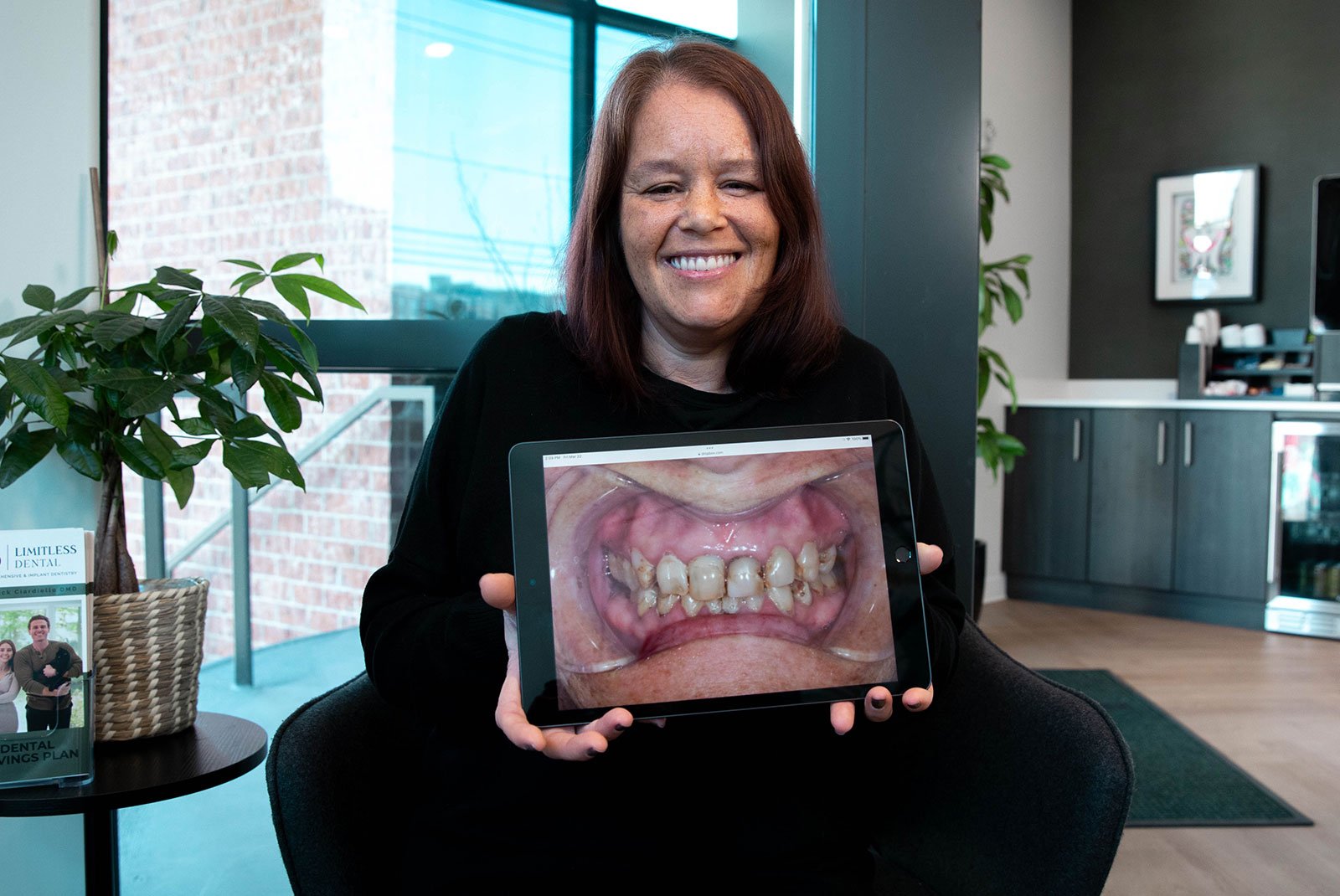
How Dental Implants Protect Against Bone Loss: A Jersey City Dentist Explains
Dental implants protect against bone loss because they replace the root of a missing tooth, not just the crown. The titanium implant post fuses directly with your jaw bone through a process called osseointegration, and that fusion keeps the bone stimulated every time you chew. Without a root or implant in the socket, the body resorbs the surrounding bone, and published research shows about 50% of the bone width can be lost in the first 12 months after extraction (Schropp et al., 2003). An implant is currently the only tooth replacement that stops this process at the source. I’m Dr. Nick Ciardiello, the lead dentist at Limitless Dental® in Jersey City. I place implants and rebuild bone every week at our office on Coles Street, and bone loss is one of the most common things patients are surprised to learn about. People come in worried about how a missing tooth looks. The bigger issue is usually what’s happening underneath, where you can’t see it on a regular mirror but a 3D x-ray will show in detail. This article walks through exactly what happens to your jaw bone after you lose a tooth, why implants stop that process, what to expect at a consult, and the questions you should be asking your dentist before you commit to any plan.What happens to your jaw bone when you lose a tooth
Your jawbone is alive. It is not a static piece of structure. Like the rest of your skeleton, it remodels constantly based on the load it carries. The roots of your teeth transmit chewing forces down into the bone, and that pressure signal is what tells the bone to stay dense and stay where it is. When a tooth is extracted, that signal stops. The bone in that area starts to shrink, and the shrinking begins almost immediately. A landmark 2003 clinical study by Schropp and colleagues followed patients for 12 months after a single tooth extraction. They found that the ridge of bone where the tooth used to sit lost roughly 50% of its width during that first year, and most of the loss happened in the first three months (Schropp L, Wenzel A, Kostopoulos L, Karring T. Int J Periodontics Restorative Dent 2003;23(4):313-323). A separate systematic review by Tan and colleagues in 2012 confirmed similar dimensional changes across the published literature (Tan WL, Wong TL, Wong MC, Lang NP. Clin Oral Implants Res 2012;23 Suppl 5:1-21). Van der Weijden’s 2009 systematic review pulled the same conclusion together across decades of human studies (Van der Weijden F, Dell’Acqua F, Slot DE. J Clin Periodontol 2009;36(12):1048-1058). Three independent reviews. Same answer. The bone disappears, and most of the disappearance happens fast.Why this matters beyond the missing tooth
Bone loss is not just a number on a study. In my practice I see real patients living with the consequences:- Neighboring teeth shift into the empty space, throwing off the bite
- The face starts to look sunken in that area because the bone supporting the cheek and lip is gone
- Dentures stop fitting as the ridge they sit on continues to shrink, year after year
- Future implant placement becomes harder, because there is less bone left to anchor into
- The remaining teeth take on more chewing force than they were designed for, which accelerates wear and fractures
How a dental implant stops the process
A dental implant is a small titanium post that we place into your jawbone in the spot where the tooth root used to be. Over the following weeks, bone cells grow onto and into the surface of the implant. That biological fusion is called osseointegration, and it is the reason implants work the way they do. Once the implant has integrated, it does the same job the tooth root used to do. Every time you chew, force travels through the crown, down through the implant, and into the surrounding bone. The bone gets the load signal it needs, and it stays dense. Published outcomes for implants placed with sound protocol are excellent. For implants placed into fresh extraction sockets, Lang and colleagues’ 2012 systematic review pooled survival data and reported approximately 98.4% survival at one year when patient selection and protocol are correct (Lang NP, Pun L, Lau KY, Li KY, Wong MC. Clin Oral Implants Res 2012;23 Suppl 5:39-66). The clinical benchmark we still use today is minimal annual bone loss around the implant after the first year of loading, which is what tells us the bone is staying preserved long-term. Translation. A well-placed implant doesn’t just replace the tooth you see. It protects the bone you don’t see, and it does it for the long haul.Why a bridge or a denture doesn’t do the same thing
Patients ask about bridges and dentures constantly because they are usually less expensive up front. They are real options for some cases, but they don’t address bone loss. A bridge sits on top of the gum. It restores the look of the missing tooth and gives you something to chew on, but nothing replaces the root. The bone underneath the bridge continues to shrink because there is no load going into it. A removable denture is even less protective. It rests on the gum, transmits some load to the underlying ridge, but the load is poorly distributed and the ridge keeps shrinking year after year. That’s why a denture that fits beautifully today often feels loose three or four years from now. The bone supporting it has moved. There is a deeper comparison of these trade-offs on our dentures vs. dental implants page if you want to dig in. This is the central trade-off. A bridge or denture is cheaper today. An implant is the only option that preserves what makes a future replacement possible.What to expect at a consult at Limitless Dental
Here is what we’ll do together:- 3D image of your jaw bone (CBCT scan). Regular x-rays only show two dimensions. A CBCT scan shows your bone in three dimensions, so I can measure exactly how much bone is left, where the nerves run, and where the sinuses sit. Most patients are surprised by what’s there and what isn’t.
- Pearl AI review of your x-rays. We use a color-coded artificial-intelligence overlay that flags areas of bone loss, decay, and other findings the human eye can miss. It’s a second set of eyes on your diagnostics.
- Honest conversation about timing. If you still have the tooth and it’s hopeless, we’ll discuss whether an immediate implant the same day as the extraction is appropriate. You can read more about that approach on our immediate dental implants in Jersey City post. Same-day placement isn’t right for every case, but when it is, it saves a lot of bone.
- Walk-through of the lab side. Your crown, custom abutment, or full-arch prosthesis is built at our in-house Limitless Lab, on the same level as the operatories. You can see the printers, the mill, and the case being built for you.
- Clear cost breakdown. We walk through what’s covered, what isn’t, and what financing makes sense. For patients without dental insurance, we offer an in-office Limitless Dental Savings Plan starting at $549 per year (not insurance, an in-office discount membership). We also work with CareCredit, Proceed Finance, Sunbit, and Cherry for monthly payment plans.
What you should ask your dentist about bone loss
Whether you come to us or somewhere else, these are the questions to bring to any implant consult:- “How much bone do I actually have left? Can I see my 3D scan?”
- “If I wait six months to do this, how much bone do you expect me to lose by then?”
- “Am I a candidate for an immediate implant the same day as the extraction?”
- “Will I need a bone graft? If yes, why, and what kind?”
- “How will you know the implant has fully integrated before you load it?”
- “What is your protocol if the implant fails to integrate?”
Frequently asked questions
How do dental implants prevent bone loss?
Dental implants prevent bone loss by transmitting chewing forces into the jaw bone the same way a natural tooth root does. The titanium implant post fuses with the bone through osseointegration, and the continued load signal keeps the bone dense. Without that signal, the body resorbs the bone.What happens to your jawbone when you lose a tooth?
When you lose a tooth, the bone in that socket starts shrinking almost immediately because the chewing-force signal that kept it dense is gone. The neighboring teeth often shift into the space, and the gum and bone supporting the cheek and lip in that area can recede over time.How much bone do you lose after a tooth extraction?
Published clinical research found that the ridge of bone where the tooth used to sit lost roughly 50% of its width during the first 12 months after extraction, with most of the loss happening in the first three months (Schropp et al., 2003). Multiple systematic reviews have confirmed similar dimensional changes in human studies.Can a dental implant reverse bone loss?
An implant does not directly grow back bone that has already been lost, but bone grafting performed at the time of implant placement can rebuild missing bone, and the implant itself then preserves the new bone going forward. The earlier you place the implant after extraction, the less rebuilding is usually needed.How long after losing a tooth does bone loss start?
Bone resorption starts within days of the extraction, and most of the dimensional change happens in the first three to six months. That’s why we plan implant timing during the extraction visit, not months later.Do dentures cause bone loss?
Standard removable dentures don’t cause bone loss directly, but they don’t stop it either. Because dentures rest on the gum without anchoring into bone like a root would, the underlying ridge continues to shrink year after year, which is why a denture that fits well today often feels loose a few years later. Implant-supported dentures are different. They anchor into implants, which preserves bone the way a single implant does.What is osseointegration and why does it matter for bone preservation?
Osseointegration is the biological process where your jaw bone cells grow onto and into the surface of a titanium implant, forming a direct structural connection. This is what allows the implant to act like a tooth root, transmitting chewing force into the bone so the bone stays loaded and stays dense. Without osseointegration, an implant would just sit in the bone like a screw in a wall, not preserve it.Can you still get a dental implant if you already have bone loss?
Yes, in most cases. If you’ve already lost significant bone, we may rebuild the area with a bone graft before or at the same time as placing the implant. For severe bone loss across an entire arch, an All-on-4 implant solution can often anchor into the bone that remains without needing extensive grafting. The 3D CBCT scan at your consult is what tells us which path applies to your case.The takeaway
Bone loss after tooth loss is not a future problem. It starts within days and most of it happens in the first year. A dental implant is the only tooth replacement that addresses bone loss at the source, because it replaces the root and restores the load signal the bone needs to stay where it is. If you have a missing tooth, a failing tooth, or a denture that no longer fits the way it used to, getting a 3D image of your jaw bone is the right first step. You’ll know exactly what you’re working with and what your real options are. To schedule a consult at Limitless Dental® in Jersey City, call us at (551) 525-8284 or visit our dental implants page to learn more. We see patients from Downtown Jersey City, Hoboken, and the surrounding Hudson County neighborhoods, and we’ll walk you through what your specific case looks like.Ready to take the next step with Limitless Dental®? Request an appointment online or call our Jersey City office at (551) 525-8284.